


The factory of the future is not defined by isolated automation projects or disconnected digital pilots. It requires a shift away from functional silos and legacy operating models toward an integrated, analytics-driven decision system. This system aligns manufacturing strategy, operations, pricing, and capital allocation around true economic performance.
Improving productivity at scale takes more than deploying new technology or collecting more data. It requires changing how manufacturing decisions are made. Those decisions must be based on accurate cost, margin, and operational analytics. Manufacturers that succeed with factory of the future initiatives focus on four essential steps.
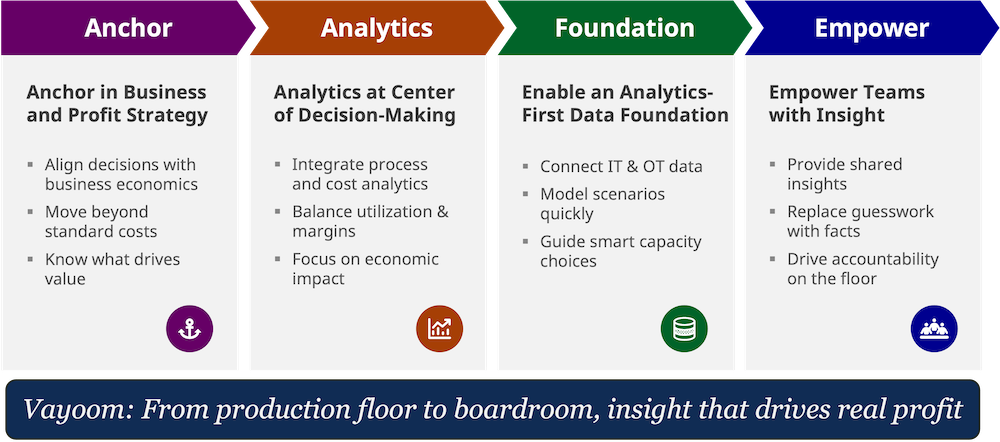
1. Anchor the Factory of the Future in Business and Profit Strategy
The factory of the future should not operate as a standalone digital transformation initiative. It must be embedded into the overall manufacturing and business strategy. Operational decisions should connect directly to market demand, customer profitability, pricing strategy, and capital efficiency. Tactical actions must consistently support long-term strategic goals.
This shift requires moving beyond traditional cost accounting. Manufacturers need cost and margin analytics that reflect how products, processes, and resources truly create and consume value. Vayoom provides manufacturers with clear financial and operational visibility, enabling realistic transformation roadmaps that balance short-term EBITDA improvement with long-term growth and resilience.
2. Put Integrated Manufacturing Analytics at the Center of Decision-Making
The decision system of the factory of the future changes how work gets done. It extends beyond lean manufacturing and operational excellence programs by integrating them with detailed cost, margin, and throughput analytics.
Instead of optimizing isolated metrics, manufacturers can evaluate trade-offs across operations, pricing, and product mix using a single source of truth. Vayoom’s True Product Cost analytics connect operational behavior directly to financial outcomes. This allows leaders to drive productivity improvement while protecting margins and strategic priorities.
3. Build a Modern Data and Analytics Foundation for Industry 4.0
Technology creates value only when it enables better decisions. IT and OT systems must be designed around a shared data and analytics foundation that connects operational data, cost drivers, and financial outcomes across functions.
An analytics-first approach allows manufacturers to model scenarios, test assumptions, and adapt quickly to change. Vayoom complements Industry 4.0 investments by adding a financial intelligence layer. This turns operational data into actionable insights that improve manufacturing profitability across the supply chain.
4. Empower Employees with Financial and Operational Insight
People remain the backbone of the factory of the future. They perform best when supported by clear insights rather than overwhelmed by complexity or rigid processes. Employees need decision-ready analytics that explain what is happening, why it matters financially, and where action will have the greatest impact.
Upskilling operations and finance teams to understand cost, margin, and operational trade-offs is critical. Vayoom enables cross-functional collaboration through a shared, objective view of profitability. This embeds accountability, sustainability, and continuous improvement into daily decision-making.
From Digital Factories to Intelligent, Profitable Manufacturing Operations
The factory of the future is not about technology alone. It is about building an intelligent manufacturing decision system where strategy, operations, and pricing remain aligned through analytics. Manufacturers that adopt an analytics-first approach can achieve 30–50% productivity gains and deliver measurable EBITDA improvement.
Vayoom does not change how manufacturers run their business. It provides the analytics foundation that makes the factory of the future economically real.