

Why Vayoom
The standard approaches were never built for today’s problems.
Every conventional tool for manufacturing finance was designed to report what happened. Vayoom was designed to explain why — at the product level, in real time, before margin is already lost.
The Status Quo
Your enterprise systems are excellent. They just weren’t built for this.
ERP. BI. EPM. These are sophisticated, well-designed systems that do exactly what they were built to do: consolidate financial data, support the close, generate reports, and enable enterprise-wide planning. The manufacturers running them aren’t doing anything wrong. But none of those systems were designed to answer the question manufacturing leaders actually need answered: which products are making money, which are destroying it, and why? That question lives one layer beneath what enterprise reporting was built to surface. It requires operational ground truth — real material consumption, real labor routing, real overhead — modeled at the product level before it rolls up into a P&L. That’s not a gap in execution. It’s a gap in what the tools were designed to do. Vayoom was built specifically to close it.
Where Standard Approaches Fall Short
Four approaches. One shared blind spot.
Most manufacturers try to solve the visibility problem with one of four approaches. Each one captures part of the picture — but misses the part that actually drives margin outcomes.
Standard costing and ERP allocations
Cost averages blended across products look clean in reports. But average cost attributed to a product is rarely that product’s true cost. When everything appears roughly profitable, nothing gets fixed, and margin leaks everywhere.
General-purpose BI and dashboards
Powerful for visualizing data that already exists. The problem isn’t the dashboard, it’s the data beneath it. BI tools surface what your ERP knows. They can’t surface what your ERP was never designed to calculate.
Spreadsheet-based cost models
The most common workaround and the most fragile. Static. Manually maintained. Disconnected from operational reality the moment the model is saved. And unable to simulate the forward impact of any decision.
Consulting and periodic analysis
Produces insight, but only at a point in time. By the delivery date, the product mix has shifted, the quoting environment has moved, and the operational picture has changed. Margin doesn’t wait for the next engagement.
The Vayoom Difference
Built from the floor up, not the P&L down.
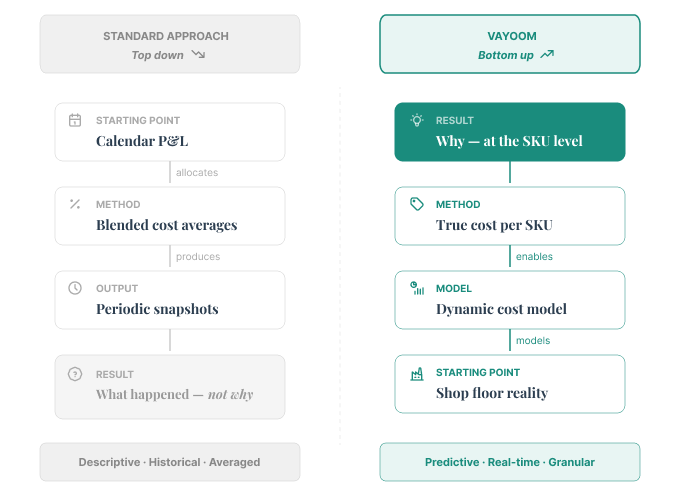
Every existing approach to manufacturing profitability starts from financial outputs and works backward. Vayoom starts from operational reality and works forward. That inversion is the crux that makes the Vayoom Core different, and the reason it surfaces what others miss.
The True Product Cost™ methodology models manufacturing operations as the interconnected systems they are: shared resources, variable routing, product mix effects, and dynamic overhead — none of it averaged, all of it attributed at the SKU level. The result isn’t a report. It’s a financial truth your enterprise systems can actually act on.
“Efficiency improvements and cost-cutting alone do not guarantee increased profitability. You have to know which products are worth improving and which ones aren’t.”
2-10%
EBIT lost annually despite modern enterprise systems
87%
Of improvement initiatives yield little to no financial gain
30%
Of products typically generate the majority of earnings
Manufacturing Leadership Council — 2024
Data Mastery: A Key to Industrial Competitiveness
Vendors offer a false sense of progress using secondary metrics
Spreadsheet remains the primary tool for financial analysis
KPIs are not tied to data governance responsibilities
Focus is on collecting more data without business strategy alignment
Significant gap exists between data strategy and overall business strategy
The floor knows things the P&L doesn’t
How it Works Differently
Four principles that separate Vayoom from every alternative.
These aren’t feature descriptions. They’re the architectural decisions that determine what’s possible — and what isn’t — when you’re trying to find out where your margin actually goes.
PRODUCT-LEVEL TRUTH
Profitability at the SKU, not the segment.
Vayoom attributes cost and margin at the individual product and customer level, without the distortion of averages or allocations. What looks healthy at the segment level often conceals products that are actively destroying margin.
DYNAMIC, NOT STATIC
A live model, not a periodic snapshot.
Standard cost models are frozen at the moment they’re built. Vayoom models costs dynamically, so every quote, every scheduling decision, and every operational change is evaluated against current reality, not last quarter’s averages.
PREDICTIVE, NOT DESCRIPTIVE
Forward-looking by design.
Most analytics answers the question: what happened? Vayoom is built to answer: what will happen if? Simulate the margin impact of a new quote, a product mix shift, or an operational improvement before committing resources.
OPERATIONS MEETS FINANCE
The floor and the P&L, finally connected.
Finance and operations routinely see different numbers for the same reality. Vayoom builds from operational ground truth and surfaces it in financial terms, so the gap between what the floor knows and what finance reports closes for the first time.
COMPLEMENTARY, NOT COMPETITIVE
Vayoom doesn’t ask you to replace what’s working. It provides the operational cost layer your ERP, BI, and EPM platforms need to plan and report accurately — the ground-floor data that makes the systems you’ve already invested in more valuable.
BUILT FROM PRACTICE
The methodology behind Vayoom didn’t come from a software team modeling how manufacturing ought to work. It came from decades of hands-on work with distressed manufacturers identifying, repeatedly, the same gap between what enterprise systems reported and what was actually happening.
How it Fits
Your enterprise systems were built to answer what happened. Vayoom was built to answer why.
That’s not a criticism of what those systems do. It’s a description of where Vayoom sits. Enterprise platforms are built for financial discipline at scale: consolidation, closing, forecasting, reporting. Vayoom is built for operational cost truth at the product level: what each SKU actually costs, which customers actually generate margin, and where the gap between financial performance and operational reality is widest.
Together, they give you something neither provides alone — an enterprise financial picture grounded in product-level operational reality.
ENTERPRISE SYSTEMS
Financial consolidation, closing, forecasting, reporting
Designed top-down across complex organizations
Excellent at answering what happened
Cost averages and overhead allocations at scale
Built for enterprise planning and compliance

VAYOOM
Operational cost truth at the product and customer level
Built bottom-up from the shop floor
Built to answer why it’s happening
Granular cost attribution, dynamically modeled per SKU
Built for profitability decisions that have to be right
VAYOOM
Operational cost truth at the product and customer level
Built bottom-up from the shop floor
Built to answer why it’s happening
Granular cost attribution, dynamically modeled per SKU
Built for profitability decisions that have to be right
ENTERPRISE SYSTEMS
Financial consolidation, closing, forecasting, reporting
Designed top-down across complex organizations
Excellent at answering what happened
Cost averages and overhead allocations at scale
Built for enterprise planning and compliance
Every profit conversation starts with knowing where you stand.
No data required. No obligation. Just clarity.