

Profit Targeting
Knowing your costs isn’t enough.
You need to know exactly what to do about them.
Product stratification tells you which products need cost reduction, which need revenue recovery, and which need to be protected. And because most products share resources, no action can be evaluated in isolation. That holistic precision is what turns cost intelligence into margin improvement, without destroying what’s already working.
<10%
Of manufacturers have a systematic process for translating cost data into operational targets
60%
Of a typical product portfolio sits in Mid and Tail tiers, where targeting delivers the most return
6%
Average EBIT improvement from targeted improvements vs. <2% from across-the-board cost cuts
40%
Of across-the-board cost reduction programs cause measurable financial damage to the business
The Problem
Most improvement programs don’t fail in execution. They fail in targeting.
When manufacturers face margin pressure, the instinct is to cut broadly — reduce headcount, trim overhead, negotiate supplier rates across the board. These decisions feel decisive. But without knowing which products are driving the problem and why, broad action is as likely to damage profitable operations as it is to fix unprofitable ones.
The deeper issue is that most products share resources — equipment, labor, logistics, overhead. An action taken on one product doesn’t stay contained to that product. It reallocates shared costs across the portfolio, and those reallocations can quietly erode the margin of products that were never the target. Without a holistic model of those interdependencies, improvement programs routinely damage what they were never meant to touch.
“The question was never whether to improve. It was what to improve — and whether the action would hurt everything else that shared those resources.”
No mechanism to translate cost data into operational priorities
Fewer than 10% of manufacturers have a systematic process for turning cost visibility into specific targets. The rest rely on judgment, seniority, or urgency — none of which correlate reliably with margin impact.
Broad cuts treat all products the same
Across-the-board reductions apply equal pressure to products with very different cost structures and margin profiles. High-contribution products lose operational support. Tail products absorb cuts that don’t address why they’re unprofitable.
No distinction between cost problems and revenue problems
A Mid-tier product with suppressed margin needs cost reduction. A Tail product consuming shared resources disproportionately needs repricing. These are different interventions — but without stratification, they look like the same problem.
Shared resources mean no product is an island
When products share equipment, labor, or overhead, changing the resource requirements of one affects the cost structure of all others. An improvement to a Mid-tier product can shift shared costs onto Tier 1 — turning a profitable intervention into margin erosion on your best SKUs.
Illustrative Example
“We had a process running at 6% EBIT. We decided to take action — across the board. Within two quarters it was at negative 2%. Vayoom was brought in to understand what happened and restore it.”
+6%
EBIT before broad action
-2%
EBIT after
across-the-board cuts
8 pts
margin destroyed by untargeted action
Across-the-board cuts reallocated shared resources in ways no one modeled. The products absorbing the damage were never the intended target. Based on a Vayoom client engagement.
The Vayoom Approach
Every tier has a clear instruction.
Stratification tells you exactly where to act — and how.
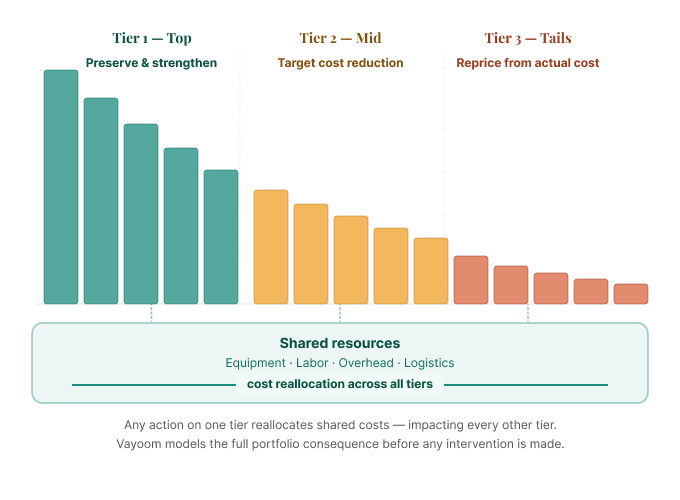
True Product Cost™ segments the portfolio into three tiers. Profit Targeting tells you what to do in each. But because products share resources, every instruction must be evaluated against the full portfolio. An action that improves one tier can shift shared costs onto another. Vayoom models the entire interdependency before any intervention is recommended.
Tier 1
Top Tier
Preserve and strengthen — your profit engine
Top-tier products generate disproportionate profitability. They require active stewardship. Stratification identifies precisely which operational conditions produce Tier 1 margin, so those conditions can be monitored and protected as mix, demand, and cost structures evolve.
Critically, shared resources mean Tier 1 products are vulnerable to actions taken elsewhere. When a Mid or Tail product’s resource requirements change, the reallocation of shared costs can quietly land on Tier 1. Profit Targeting keeps this visible before it becomes damage.
Monitor cost conditions that produce Tier 1 margin and detect drift early
Protect capacity from displacement by lower-contribution volume
Model the shared-cost impact of every Mid and Tail intervention on Tier 1
Identify improvements that can extend already-strong margins further
Ensure pricing reflects sustained cost advantage — not historical averages
Tier 2
Mid Tier
Cost reduction — targeted, not broad
Mid-tier products have real margin potential. The analysis has already identified which cost drivers are suppressing it: setup complexity, material handling intensity, quality inspection burden, or shared resource consumption.
Cost reduction on a Mid-tier product doesn’t happen in isolation. Reducing that product’s consumption of shared resources reallocates those costs across the portfolio. Vayoom evaluates every cost reduction against the full shared-resource picture before recommending action.
Setup and changeover reduction for complex configurations
Material handling and logistics cost attribution and improvement
Quality inspection burden reduction through process stabilization
Shared resource consumption rationalization — modeled across the full portfolio
Labor and machine hour allocation optimization
Tier 3
Tail Products
Revenue improvement — repricing from actual cost
Tail products are often priced from averaged estimates that obscure how much shared resource they consume. The intervention here is revenue recovery, not cost cutting.
When a Tail product is rationalized, the shared resources it consumed don’t disappear — they reallocate to the products that remain. Vayoom models the full portfolio consequence of every rationalization decision before it is made.
Price recovery built from actual cost, not market averages
Volume-adjusted margin modeling before contract commitments
Rationalization analysis with full shared-cost reallocation modeled
Customer-level profitability impact before commercial decisions
Portfolio-wide margin consequence assessed before any SKU is removed
“Every tier has a clear action. But because resources are shared, every action has consequences beyond its target. The only safe way to improve is to model the whole — and that’s what Vayoom does.”
How it Works
From cost data to operational target — the mechanism is explicit.
No other platform starts from a stratified product tier structure and uses it to derive specific operational instructions. What makes Vayoom’s approach fundamentally different is not just the targeting — it’s that every target is evaluated holistically. Because products share resources, an improvement to one product changes the cost structure of others. Vayoom models those interdependencies before any action is taken.
01
True Product Cost™ establishes the actual cost of every product
Attribute-based costing replaces averaged allocation with precision. Every indirect cost is distributed using the product and process attributes that actually drive it — setup, handling, quality, logistics, and more.
02
Stratification assigns every product to a tier
Products are segmented into Top, Mid, and Tail tiers based on revenue, cost, and margin contribution. Each tier position carries a specific operational implication — and reflects its consumption of shared resources.
03
Tier position determines the intervention
Top-tier products are monitored and protected. Mid-tier products surface specific cost drivers. Tail products surface the repricing gap. All targets are evaluated against what they would do to products sharing the same resources.
04
Scenario modeling captures every interdependency before action
Before any operational change or pricing decision is made, Vayoom models the full portfolio consequence — including how shared-cost reallocations from the intervention ripple across every other product, including Tier 1.
05
Accurate Quoting closes the loop on revenue recovery
For Tail products where repricing is the right action, Accurate Quoting builds the new price from the same cost data — giving the commercial team a defensible number that reflects true shared-resource consumption.
06
The model updates as the business evolves
As product mix, cost structures, and operational conditions change, stratification and targeting refresh automatically — so the shared-resource picture stays current and improvement programs don’t act on outdated data.
What It Enables
The decisions that protect margin require a holistic view most manufacturers don’t have.
01
Targeted cost reduction
Operational improvements focused on the specific cost drivers identified by True Product Cost™ — not broad cuts that apply equal pressure to products with fundamentally different cost profiles and shared resource dependencies.
02
Defensible revenue recovery
Pricing decisions for Tail products built from actual cost data, including their true consumption of shared resources. Repricing from a real floor eliminates the guesswork that leads to under-recovery at the point of sale.
03
Profit engine protection
Continuous visibility into the operational conditions that produce Tier 1 margin — including early detection of shared-cost drift caused by actions taken on Mid or Tail products. Your best products stay protected.
04
Full portfolio scenario modeling
Every targeted intervention is modeled before execution — including the second-order effects on every product sharing equipment, labor, and overhead. No action is approved against a partial view of the cost consequence.
05
Operational clarity for leadership teams
Finance and operations stop working from different pictures of the business. Profit Targeting gives both functions a holistic set of priorities — one that accounts for resource interdependencies rather than treating products as independent cost objects.
06
Continuous targeting as conditions change
As mix, cost structures, and shared resource consumption patterns shift, stratification and targeting refresh automatically — so the improvement program stays calibrated to current operational reality across the full portfolio.
Every profit conversation starts with knowing where you stand.
No data required. No obligation. Just clarity.